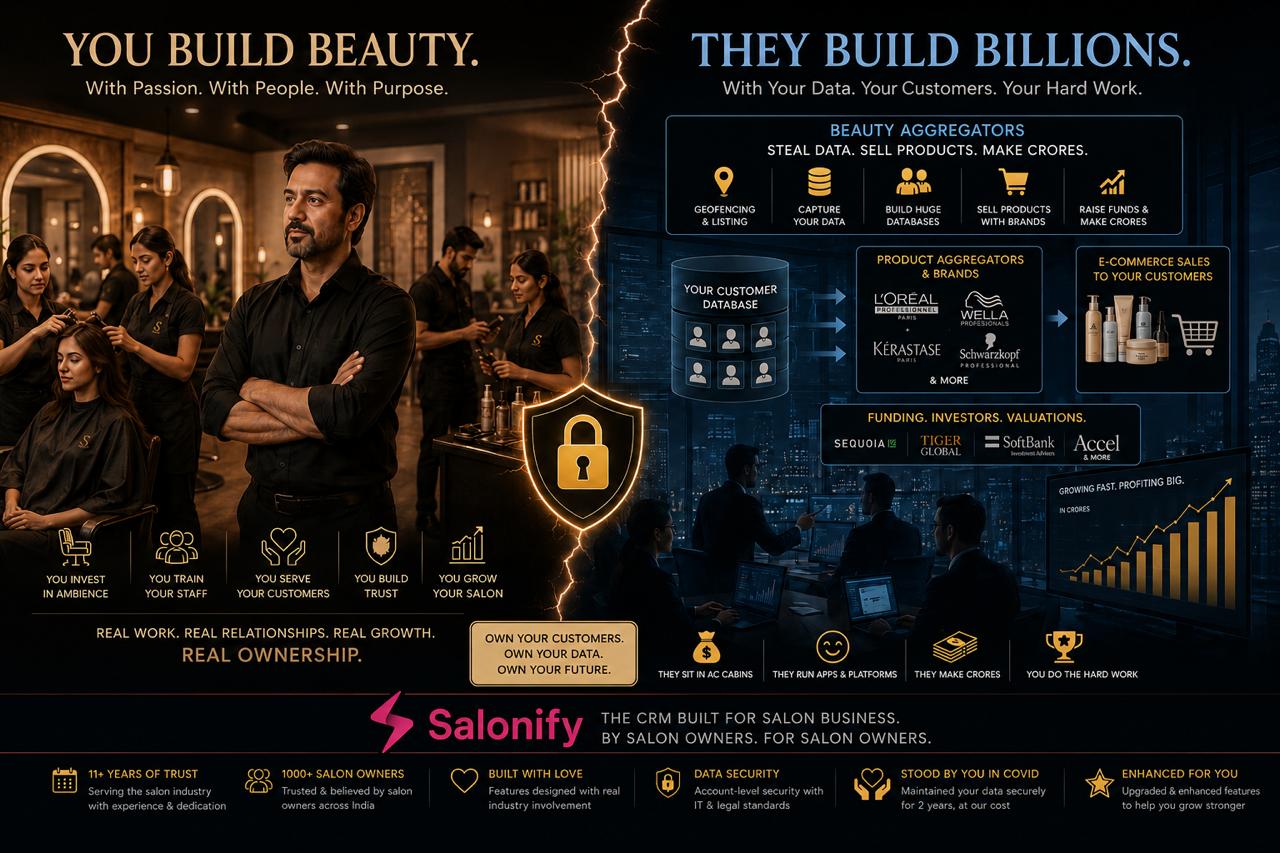
Are Salon Owners Slowly Building Someone Else’s Business Instead of Their Own?
This is something every salon owner, spa owner, stylist, beautician and beauty entrepreneur should seriously think about.
For years, salon businesses have invested heavily into:
- Premium interiors
- Ambience and customer comfort
- Staff hiring and salaries
- Technical training
- Brand building
- Local trust
- Customer relationships
- Service quality
- Hygiene standards
- Daily operations
- Rentals and maintenance
A salon is not just a “service point.”
It is built with years of effort, emotional investment, reputation and team contribution.
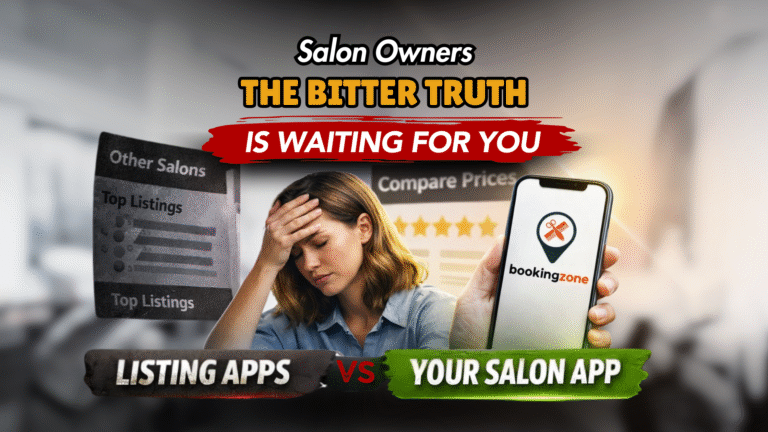
But today, marketplace and aggregator platforms are positioning themselves between salons and their own customers.
And the biggest question is:
Why are salon owners allowing someone else to control customer discovery, customer communication and customer retention?
We have seen this pattern for years.
From 2011–2015:
- Groupon
- Nearby
- Purplle
- Multiple coupon and deal platforms
Then from 2023 onwards:
- Gloup
- Luzo
- Barberra
- Home-service marketplaces
- Beauty booking aggregators
- Hyperlocal discovery apps
Hundreds of companies entered the beauty industry ecosystem.
But let’s understand something very clearly.
Most of these founders are not salon owners.
They are not stylists.
They are not beauticians.
They have never managed salon operations, staff pressure, customer retention, walk-ins, rentals or ground-level salon struggles.
They are technology and marketplace businesses.
And their model is built around one thing:
Owning customer behaviour.
Their strategy is simple:
- Use geofencing to target local salon audiences
- List salons area-wise
- Position competitors beside each other
- Push discount-driven discovery
- Collect customer databases
- Control repeat booking behaviour
- Sell visibility back to salons
- Create dependency on platform traffic
And in many cases, salons don’t even realise how much control they are slowly losing.
Today customers remember:
“Which app gave discount?”
instead of:
“Which salon gave good service?”
That is where the real shift is happening.
The dangerous part is not just discounting.
The dangerous part is DATA OWNERSHIP.
Because once the platform controls customer data:
- Customer phone numbers
- Service behaviour
- Booking patterns
- Spending capacity
- Favourite services
- Purchase habits
- Location behaviour
the salon slowly becomes only a service fulfilment center.
And now another major shift is happening.
Many beauty booking marketplaces are also partnering with product-selling aggregators and commerce platforms.
This means:
The same customers generated through YOUR:
- salon ambience
- staff expertise
- service quality
- customer handling
- years of local trust
are now being remarketed to for:
- Skincare products
- Haircare brands
- Beauty subscriptions
- Cosmetic sales
- Marketplace product campaigns
- Influencer commerce
- Sponsored recommendations
The salon does the hard work.
The platform monetises the customer ecosystem.
Salon owners handle:
- Rent
- Salaries
- Electricity
- Staff management
- Customer complaints
- Infrastructure
- Local marketing
- Operations pressure
while aggregator platforms continue scaling using salon-generated customer databases.
And the irony?
Some of these marketplace companies are now:
- Raising crores in funding
- Scaling aggressively
- Expanding nationally
- Moving toward IPOs
- Building investor value
while many salon owners themselves still struggle with:
- Customer retention
- Employee retention
- Discount pressure
- Operational costs
- Margin reduction
COVID accelerated another major shift.
Platforms like:
- YesMadam
- Urban Company
- Home-service aggregators
introduced flexible earning and commission-based service culture.
Many salon professionals got attracted to:
- Flexible timings
- Incentives
- Per-service earnings
- Freelancer freedom
and left permanent salon careers.
But over time, many skilled professionals lost:
- Career stability
- Brand identity
- Team culture
- Long-term growth
- Professional designation
A “Senior Stylist”
became just another “service provider” inside an app ecosystem.
A “Creative Director”
became another profile competing for algorithm rankings.
Highly trained professionals who spent years learning beauty, aesthetics and client handling slowly entered gig-based dependency systems.
Now ask yourself honestly as a salon owner:
Why should someone else own the relationship with customers YOU built?
Your customers came because of:
- Your ambience
- Your hospitality
- Your service standards
- Your staff effort
- Your salon reputation
- Your consistency
Then why not build your OWN digital ecosystem?
Today technology is affordable.
For a very small investment, salons can now build:
- Their own digital identity
- Their own booking platform
- Their own CRM
- Their own loyalty system
- Their own WhatsApp engagement
- Their own repeat customer strategy
- Their own membership ecosystem
- Their own branded app or website
The future belongs to salon businesses that:
- Own their customer database
- Own their branding
- Own customer communication
- Build direct trust
- Empower their own staff
- Build local community relationships
instead of becoming dependent on third-party marketplaces.
Technology should empower salon businesses — not slowly replace their identity.
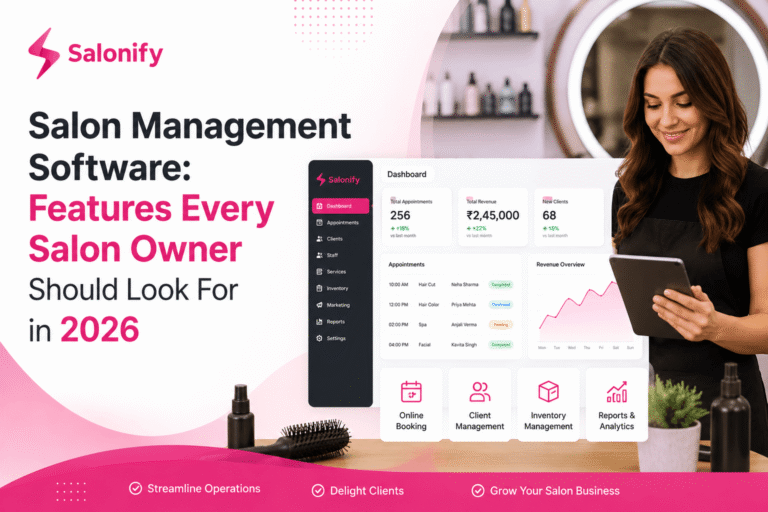
This is exactly why Salonify was built.
Salonify is not a marketplace.
Salonify never positioned itself as an aggregator platform.
Salonify is a CRM and salon business ecosystem built over the last 11+ years exclusively for the beauty & wellness industry.
It was built by deeply involving:
- Salon owners
- Salon managers
- Stylists
- Beauty consultants
- Front desk teams
- Real operational workflows
The founders themselves sat inside salons as managers, interacted directly with salon teams, visited salons physically, and spent years understanding genuine industry pain points from the ground level.
Salonify was built with love and respect for the salon industry.
Every feature was designed to help salons:
- Grow their business
- Showcase their own brand
- Retain their own customers
- Build customer loyalty
- Manage operations independently
- Strengthen staff coordination
- Build long-term business value
Most importantly:
Salonify believes salon customer data belongs to the salon owner — not to a marketplace.
That is why strong information technology and account-level data security standards are maintained to protect every salon’s business information responsibly.
Today, Salonify is trusted and believed in by 1000+ salon owners.
And through all these years, Salonify never played the role of a marketplace trying to control customer ownership.
Even during COVID shutdown periods, when salons were closed for a year, Salonify continued maintaining client data securely for nearly two years by continuing server infrastructure and operational support.
Instead of exploiting the situation, the focus during that period was:
- Enhancing features
- Strengthening systems
- Improving automation
- Building better tools
so that salons could restart stronger once businesses resumed.
Because real technology partners stand with the industry — not above the industry.
Caution ⚠️
Would genuinely love to hear thoughts from salon owners, beauty professionals and industry leaders on this.
SalonOwners #BeautyIndustry #SalonBusiness #SalonGrowth #BeautyEntrepreneurs #SalonMarketing #SalonTechnology #DigitalSalon #Salonify #BeautyBusiness